Resources · EU2023-1542

Regulation (EU) 2023/1542
Compliance Documents.

This page is the destination of the QR code marked on ATB batteries (Article 13(6) of the EU Battery Regulation). It gives access to the label information, the EU declaration of conformity, the information on prevention and management of waste batteries, and the supporting declarations issued by ATB Power as manufacturer for its valve-regulated lead-acid batteries (AGM and GEL ranges).

Manufacturer

Identification.

Article 38(7) — manufacturer of record

Manufacturer
ATB Power Limited (brand: ATB Power), 95 Wai Yip Street, Kwun Tong, Hong Kong SAR
E-mail / web
· atbpower.com
Products
ATB valve-regulated lead-acid (VRLA) batteries, AGM and GEL ranges: AGM ranges GP, DC, FT, HR, LC, 2V, SSL; GEL ranges 2VG, DCG
Battery category
Industrial batteries (Article 3, point (13)); the SSL start-stop range is an SLI battery (Article 3, point (12))
Conformity assessment
Module A, internal production control (Annex VIII, Part A) — no notified body
EU declaration of conformity
ATB-DoC-2026-001, 2026-09-27 (below)
Due diligence report (Art. 52(3))
Not required: manufacturer below the EUR 40 million threshold of Article 47; Chapter VII applies from 18 August 2027 (Regulation (EU) 2025/1561)
QR code printed on ATB batteries, linking to this page
https://atbpower.com/eu1542
SVG · PNG
Declarations & Documents

Self-declarations of the manufacturer.

Issued by ATB Power Limited under its sole responsibility on the basis of the technical documentation held for the products. View online or download the PDF. Documents are revised when the products, the requirements or the evidence change; the date of the last update is printed on each document.

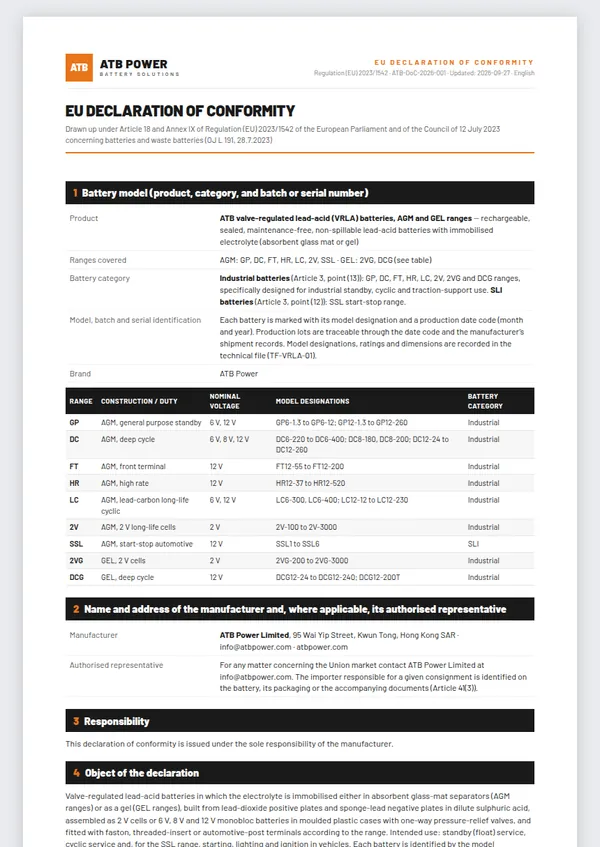
EU Declaration of Conformity

EU Declaration of Conformity — ATB VRLA Batteries (AGM and GEL)

Annex IX declaration No. ATB-DoC-2026-001 covering the AGM ranges GP, DC, FT, HR, LC, 2V and SSL and the GEL ranges 2VG and DCG. Module A; IEC 60896-21/-22, EN 50342-1/-6, UN SP 238.

PDFATB-DoC-2026-001Updated 2026-09-27
Compliance Statement

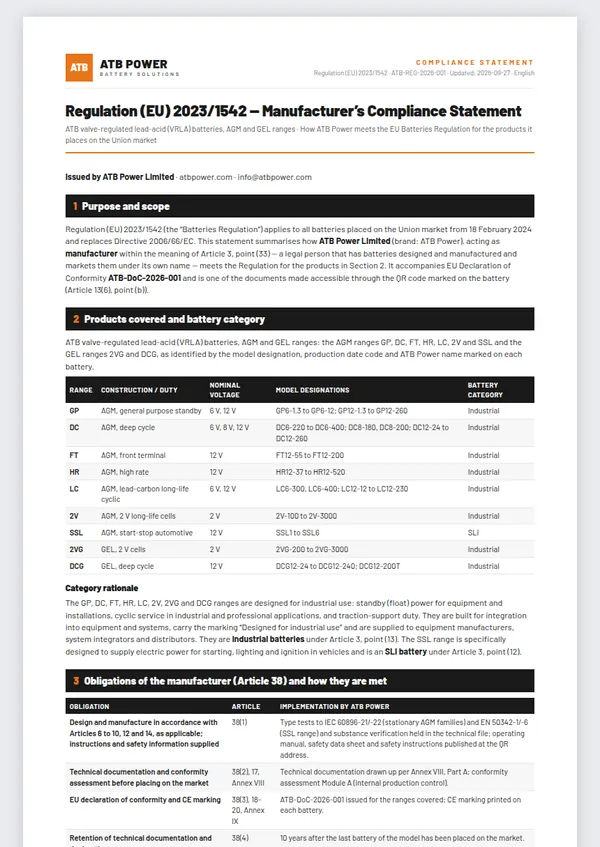
Regulation (EU) 2023/1542 — Manufacturer’s Compliance Statement

How ATB Power, as manufacturer under Article 3(33), meets the Regulation: product coverage and category, obligations of Article 38, requirement-by-requirement position, roles of importer and distributor, key dates.

PDFATB-REG-2026-001Updated 2026-09-27
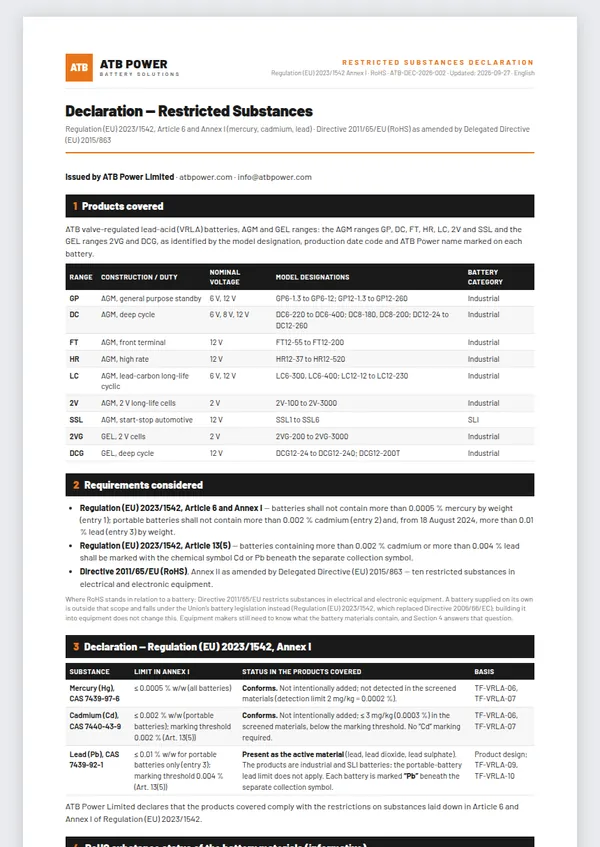
Restricted Substances

Declaration — Restricted Substances (Annex I · RoHS)

Mercury, cadmium and lead status under Article 6 and Annex I; “Pb” marking; RoHS substance screening of the case, terminal, sealing compound and separator materials.

PDFATB-DEC-2026-002Updated 2026-09-27
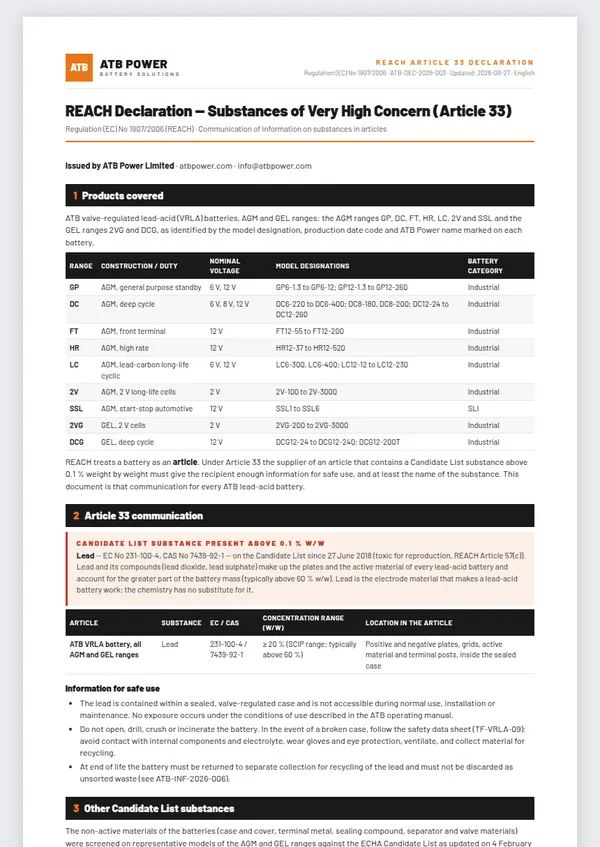
REACH SVHC

REACH Article 33 Declaration — Substances of Very High Concern

Lead is present above 0.1 % w/w as the active material; safe-use information; other Candidate List substances (253 entries, 4 Feb 2026) screened; SCIP data.

PDFATB-DEC-2026-003Updated 2026-09-27
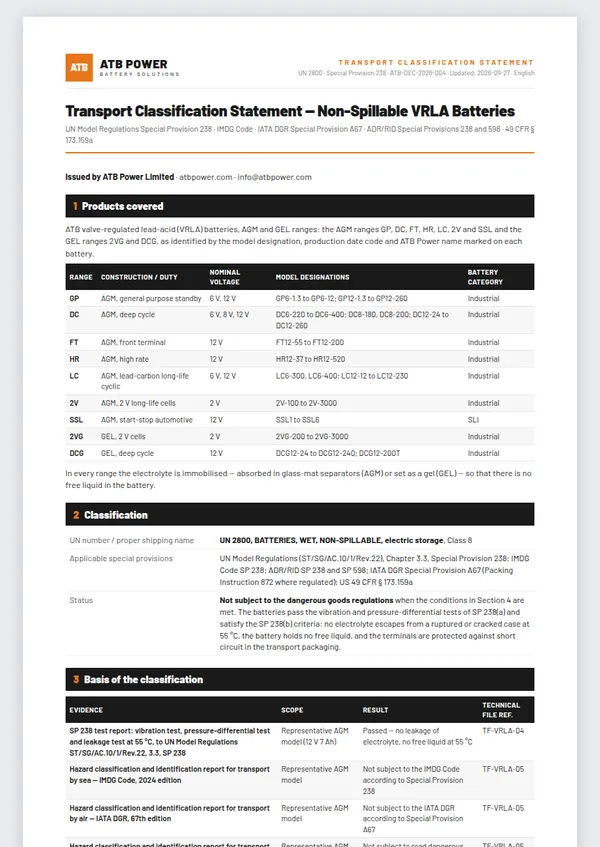
Transport

Transport Classification Statement — Non-Spillable VRLA

UN 2800, Special Provision 238: not subject to IMDG, IATA DGR (A67) or ADR (SP 238/598) when terminals are protected. Evidence and conditions of shipment.

PDFATB-DEC-2026-004Updated 2026-09-27
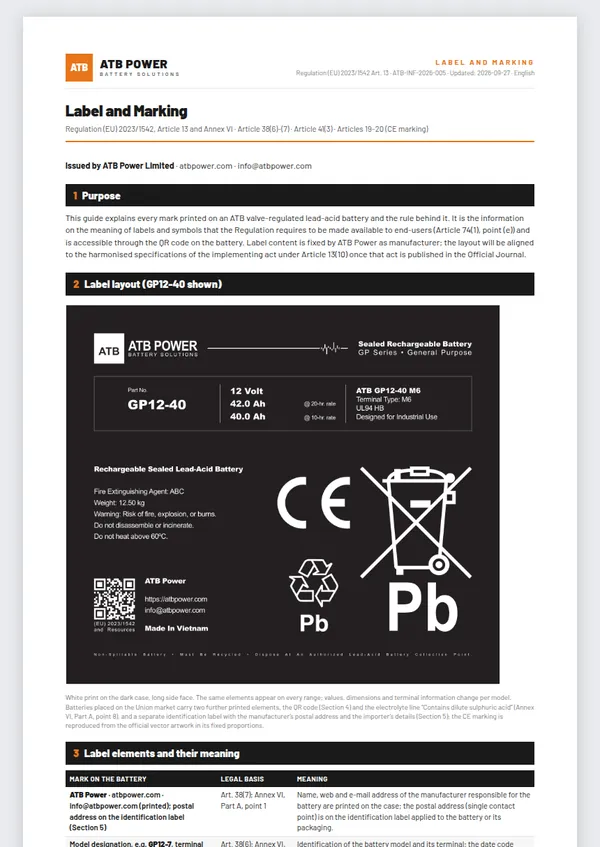
Label and Marking

Label and Marking

Every mark on the battery and its legal basis: manufacturer identification, model and date code, separate collection symbol, Pb, CE, QR code, importer identification, symbol sizing.

PDFATB-INF-2026-005Updated 2026-09-27
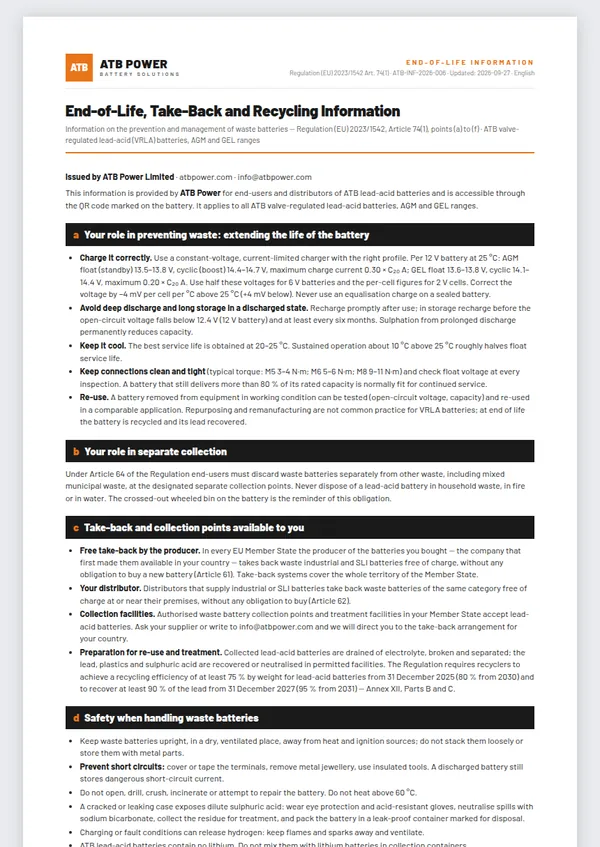
End-of-Life Information

End-of-Life, Take-Back and Recycling Information

Prevention, separate collection, take-back points, safe handling of waste batteries, meaning of symbols and environmental impact — Article 74(1), points (a) to (f).

PDFATB-INF-2026-006Updated 2026-09-27
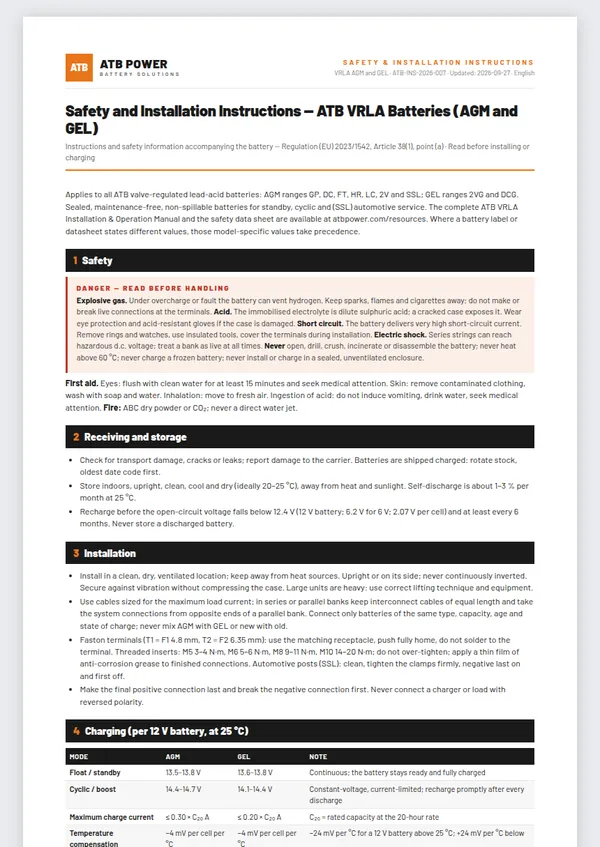
Safety Instructions

Safety and Installation Instructions — VRLA AGM and GEL

Instructions and safety information accompanying the battery: hazards, first aid, storage, installation, charging settings for AGM and GEL, maintenance, transport and end of life.

PDFATB-INS-2026-007Updated 2026-09-27
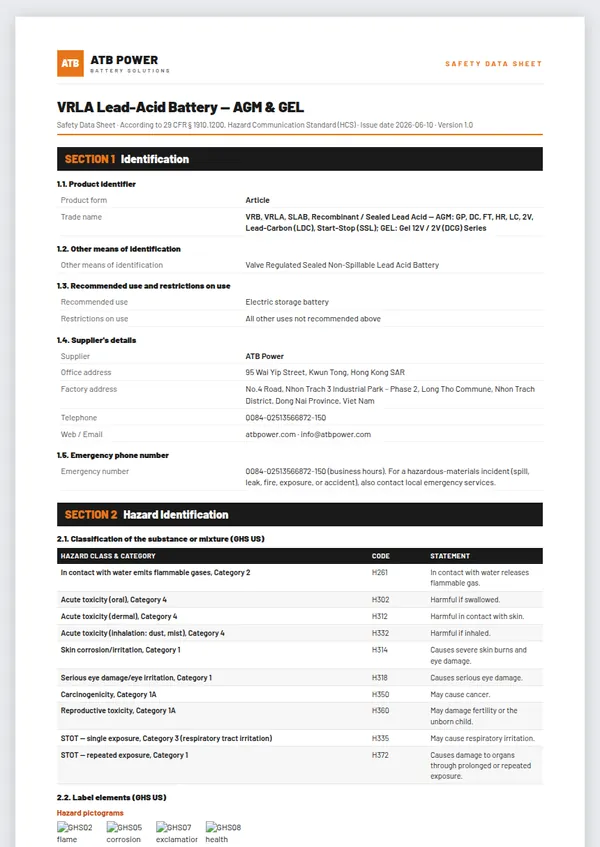
Safety Data Sheet

VRLA AGM & GEL Battery SDS

GHS 16-section safety data sheet for ATB valve-regulated lead-acid batteries: composition, hazards, first aid, handling, transport (UN 2800, non-spillable) and disposal.

PDFEdition 2026
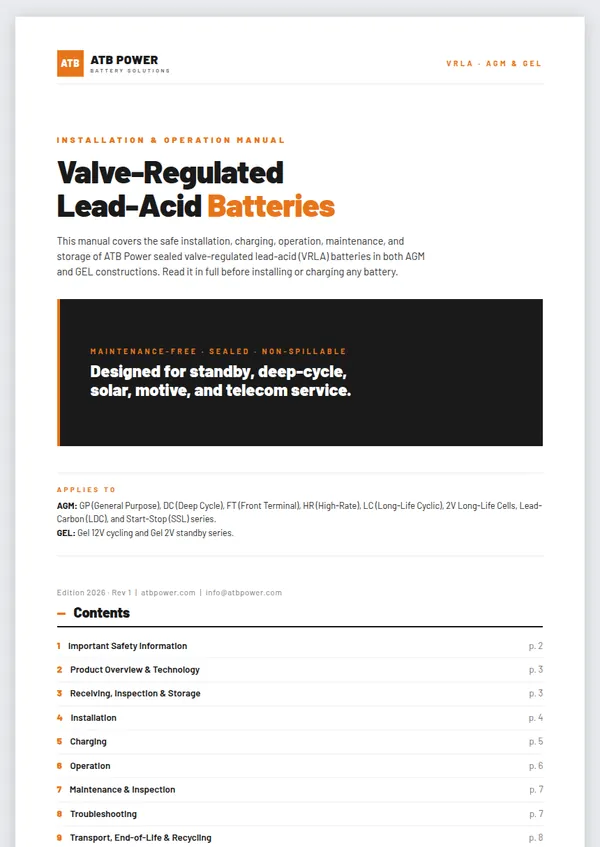
Operating Manual

VRLA AGM & GEL Installation & Operation Manual

Full instructions: safety, receiving and storage, installation, charging profiles, operation, maintenance, troubleshooting, transport and recycling.

PDF · 8 pagesEdition 2026

The technical documentation behind these declarations (Annex VIII) stays with ATB Power. Market surveillance authorities receive it on reasoned request; customers who need extracts for their own compliance records can obtain them under a confidentiality agreement. Write to .

Label Information

Product ranges and what the label states (Annex VI, Part A).

Model-specific values — model designation, date of manufacture, weight and capacity — are printed on each battery. The information common to the ranges is given here.

RangeConstruction / dutyNominal voltageModel designationsCategory
GPAGM, general purpose standby6 V, 12 VGP6-1.3 to GP6-12; GP12-1.3 to GP12-260Industrial
DCAGM, deep cycle6 V, 8 V, 12 VDC6-220 to DC6-400; DC8-180, DC8-200; DC12-24 to DC12-260Industrial
FTAGM, front terminal12 VFT12-55 to FT12-200Industrial
HRAGM, high rate12 VHR12-37 to HR12-520Industrial
LCAGM, lead-carbon long-life cyclic6 V, 12 VLC6-300, LC6-400; LC12-12 to LC12-230Industrial
2VAGM, 2 V long-life cells2 V2V-100 to 2V-3000Industrial
SSLAGM, start-stop automotive12 VSSL1 to SSL6SLI
2VGGEL, 2 V cells2 V2VG-200 to 2VG-3000Industrial
DCGGEL, deep cycle12 VDCG12-24 to DCG12-240; DCG12-200TIndustrial
Manufacturer (point 1)ATB Power, web and e-mail address printed on every battery; postal address on the identification label applied to the battery or its packaging (Article 38(7)).
Identification and date (points 2, 4)Model designation, terminal type and production date code (month and year) on every battery (Article 38(6)).
Place of manufacture (point 3)“Made in …” as marked on the battery.
Weight and capacity (points 5, 6)Weight in kg; rated capacity at the 20-hour and 10-hour rates at 25 °C (Ah and cold-cranking performance on SSL batteries).
Chemistry (point 7)Rechargeable valve-regulated lead-acid; electrolyte immobilised in absorbent glass mat (AGM ranges) or as a gel (GEL ranges). Marked “Pb”.
Hazardous substances (point 8)Dilute sulphuric acid (electrolyte). Mercury below 0.0005 % w/w; cadmium below 0.002 % w/w (no Cd marking).
Extinguishing agent (point 9)ABC dry powder; carbon dioxide is also suitable. Never a direct water jet.
Critical raw materials (point 10)The electrochemical system contains no lithium, cobalt, nickel, manganese or natural graphite. The copper content of terminal inserts and the antimony content of grid alloys are being confirmed with the production site and will be listed here if either exceeds 0.1 % w/w.
Article 74(1)

Prevention and management of waste batteries.

Summary for end-users and distributors. The full text is in the End-of-Life Information document above.

(a) Prevention

Make the battery last

Correct charger profile only: AGM float 13.5–13.8 V and cyclic 14.4–14.7 V; GEL float 13.6–13.8 V and cyclic 14.1–14.4 V (per 12 V at 25 °C, temperature-compensated). Recharge promptly, never store discharged, keep at 20–25 °C. Tested working batteries can be re-used in comparable applications.

(b) Separate collection

Never in household waste

End-users must discard waste batteries separately from other waste (Article 64). The crossed-out wheeled bin on the battery is the reminder. Never in fire or water.

(c) Take-back

Free of charge, everywhere in the EU

The producer in your Member State takes back waste industrial and SLI batteries free of charge without any purchase obligation (Article 61); distributors take back the same category at or near their premises (Article 62). Ask your supplier or write to info@atbpower.com.

(d) Safety

Handling waste batteries

Upright, dry, ventilated; terminals covered against short circuit; never open, crush or incinerate; cracked cases expose dilute sulphuric acid — gloves and eye protection. No lithium in ATB lead-acid batteries: do not mix with lithium collection.

(e) Symbols

What the marks mean

Crossed-out bin: separate collection. Pb: contains lead above 0.004 %. CE: manufacturer’s declaration of conformity. QR: this page. Full guide in the Label and Marking document.

(f) Impact

Why it matters

Lead is toxic and bioaccumulative; the electrolyte is corrosive. Improper discarding contaminates soil and water. Recycling recovers the lead in a closed loop: at least 75 % recycling efficiency for lead-acid batteries from 2026 and 90 % lead recovery from 2028 (Annex XII).

Applicability

What applies to these batteries.

ProvisionApplies?Position
Art. 6 / Annex I — mercury, cadmium, leadYesConforms. Lead is the active material; the portable-battery lead limit does not apply to industrial or SLI batteries. Pb marking applied.
Art. 7 — carbon footprintNot yetConcerns rechargeable industrial batteries above 2 kWh, EV and LMT batteries; applies 18 months after the delegated and implementing acts enter into force, which are still pending.
Art. 8 — recycled contentNot yetIndustrial batteries above 2 kWh and SLI batteries: from 18 August 2028 at the earliest.
Art. 9–11 — portable / LMT performance and removabilityNoConcern portable and LMT batteries; the products are industrial and SLI batteries.
Art. 10 — industrial performance and durabilityAbove 2 kWhRechargeable industrial batteries above 2 kWh are accompanied by a document with the Annex IV, Part A performance and durability parameters.
Art. 12 — stationary battery energy storage systemsNo, as placed on the marketComponent batteries; IEC 60896-21/-22 safety type tests held in the technical file for the stationary families.
Art. 13 — labelling, marking, QR codeYesSeparate collection symbol, Pb, CE, manufacturer and model identification, capacity on SLI batteries; Annex VI Part A information and QR code applied ahead of the mandatory dates.
Art. 14 — battery management systemNoNo BMS.
Art. 17–20 — conformity assessment, EU DoC, CEYesModule A; ATB-DoC-2026-001; CE marking on the battery.
Chapter VII — due diligenceNoBelow the EUR 40 million threshold; applies from 18 August 2027.
Chapter VIII — producer registration, take-back, end-user informationYesThrough the producer in each Member State; end-user information on this page.

Source: Regulation (EU) 2023/1542 of the European Parliament and of the Council of 12 July 2023 (OJ L 191, 28.7.2023, p. 1), as amended by Regulation (EU) 2025/1561. Page last updated 2026-09-27.

Market surveillance authority, importer or customer with a documentation request?

info@atbpower.com