ATB
ATB PowerBattery Solutions
Safety Data Sheet
VRLA Lead-Acid Battery — AGM & GEL
Safety Data Sheet · According to 29 CFR § 1910.1200, Hazard Communication Standard (HCS) · Issue date 2026-06-10 · Version 1.0
SECTION 1 Identification
1.1. Product identifier
| Product form | Article |
| Trade name | VRB, VRLA, SLAB, Recombinant / Sealed Lead Acid — AGM: GP, DC, FT, HR, LC, 2V, Lead-Carbon (LDC), Start-Stop (SSL); GEL: Gel 12V / 2V (DCG) Series |
1.2. Other means of identification
| Other means of identification | Valve Regulated Sealed Non-Spillable Lead Acid Battery |
1.3. Recommended use and restrictions on use
| Recommended use | Electric storage battery |
| Restrictions on use | All other uses not recommended above |
1.4. Supplier's details
| Supplier | ATB Power |
| Office address | 95 Wai Yip Street, Kwun Tong, Hong Kong SAR |
| Factory address | No.4 Road, Nhon Trach 3 Industrial Park – Phase 2, Long Tho Commune, Nhon Trach District, Dong Nai Province, Viet Nam |
| Telephone | 0084-02513566872-150 |
| Web / Email | atbpower.com · info@atbpower.com |
1.5. Emergency phone number
| Emergency number | 0084-02513566872-150 (business hours). For a hazardous-materials incident (spill, leak, fire, exposure, or accident), also contact local emergency services. |
SECTION 2 Hazard Identification
2.1. Classification of the substance or mixture (GHS US)
| Hazard class & category | Code | Statement |
|---|
| In contact with water emits flammable gases, Category 2 | H261 | In contact with water releases flammable gas. |
| Acute toxicity (oral), Category 4 | H302 | Harmful if swallowed. |
| Acute toxicity (dermal), Category 4 | H312 | Harmful in contact with skin. |
| Acute toxicity (inhalation: dust, mist), Category 4 | H332 | Harmful if inhaled. |
| Skin corrosion/irritation, Category 1 | H314 | Causes severe skin burns and eye damage. |
| Serious eye damage/eye irritation, Category 1 | H318 | Causes serious eye damage. |
| Carcinogenicity, Category 1A | H350 | May cause cancer. |
| Reproductive toxicity, Category 1A | H360 | May damage fertility or the unborn child. |
| STOT — single exposure, Category 3 (respiratory tract irritation) | H335 | May cause respiratory irritation. |
| STOT — repeated exposure, Category 1 | H372 | Causes damage to organs through prolonged or repeated exposure. |
2.2. Label elements (GHS US)
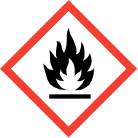
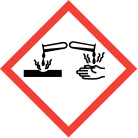
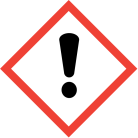
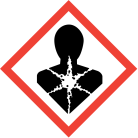
Hazard pictograms
Signal word: Danger
Hazard statements
H261 — In contact with water releases flammable gas. H302+H312+H332 — Harmful if swallowed, in contact with skin or if inhaled. H314 — Causes severe skin burns and eye damage. H335 — May cause respiratory irritation. H350 — May cause cancer. H360 — May damage fertility or the unborn child. H372 — Causes damage to organs through prolonged or repeated exposure.
Precautionary statements
Obtain special instructions before use. Do not handle until all safety precautions have been read and understood. Do not allow contact with water. Do not breathe dusts or mists. Wash hands, forearms and face thoroughly after handling. Do not eat, drink or smoke when using this product. Use only outdoors or in a well-ventilated area. Wear protective clothing, eye and face protection, and protective gloves. Immediately call a poison center or doctor. If swallowed: rinse mouth, do NOT induce vomiting. If on skin (or hair): take off immediately all contaminated clothing, rinse skin with water/shower; wash contaminated clothing before reuse. IF IN EYES: rinse cautiously with water for several minutes; remove contact lenses if present and easy to do; continue rinsing. If inhaled: remove person to fresh air and keep comfortable for breathing. If exposed or concerned: get medical advice/attention. In case of fire: use appropriate media to extinguish. Store in a dry, well-ventilated place; keep container tightly closed and locked up. Dispose of contents and container to a hazardous or special waste collection point in accordance with local, regional, national and international regulations.
2.3–2.5: No additional information available. Hazards apply to the contents if the article is compromised.
SECTION 3 Composition / Information on Ingredients
Mixture. Inorganic lead and the electrolyte (dilute sulfuric acid) are the primary components. GEL types additionally contain amorphous silicon dioxide used to immobilize the electrolyte. Other ingredients may be present depending on battery type.
| Name | CAS-No. | % wt. | GHS US classification |
|---|
| Lead | 7439-92-1 | ~50 | Carc. 2, H351; Repr. 1A, H360; Lact., H362; Aquatic Acute 1, H400; Aquatic Chronic 1, H410 |
| Lead dioxide (lead oxide) | 1309-60-0 | ~23 | Acute Tox. 4 (Oral), H302; Acute Tox. 4 (Inhalation: dust, mist), H332; Repr. 1A, H360; STOT RE 2, H373; Aquatic Acute 1, H400; Aquatic Chronic 1, H410 |
| Lead sulfate | 7446-14-2 | ~3 | Acute Tox. 4 (Oral), H302; Acute Tox. 4 (Inhalation: dust, mist), H332; Repr. 1A, H360; STOT RE 2, H373; Aquatic Acute 1, H400; Aquatic Chronic 1, H410 |
| Sulfuric acid (electrolyte) | 7664-93-9 | ~13 | Met. Corr. 1, H290; Skin Corr. 1, H314; Eye Dam. 1, H318; Carc. 1A, H350; STOT SE 3, H335; Aquatic Acute 3, H402; Aquatic Chronic 3, H412 |
| AGM glass-mat separator (AGM types) | 65997-17-3 | ~8 | Not classified |
| Silicon dioxide / gelled electrolyte (GEL types) | 60676-86-0 | 5 – 6 | Not classified |
| Battery case (ABS / polypropylene) | 9003-56-9 | ~3 | Aquatic Acute 3, H402; Aquatic Chronic 3, H412 |
Typical percentages by weight based on the manufacturer (Hengli) composition; exact proportions vary by model, size, and state of charge. AGM types use a glass-mat separator; GEL types use a gelled (silica) electrolyte in place of the AGM separator. Full text of H-statements: see Section 16.
SECTION 4 First-Aid Measures
4.1. Description of necessary first-aid measures
| General | In the finished article form, no special first-aid measures are required. The measures below apply if the product is compromised. Call a physician immediately. |
| Inhalation | Remove person to fresh air and keep comfortable for breathing. Call a poison center/doctor if you feel unwell. |
| Skin contact | Remove affected clothing and wash all exposed skin with mild soap and water, followed by a warm-water rinse. Call a physician immediately. Wash contaminated clothing before reuse. |
| Eye contact | Immediately rinse with water for a prolonged period while holding the eyelids wide open. Transport the casualty to an eye doctor/hospital; continue rinsing during transport with isotonic saline, alternatively with water. |
| Ingestion | Rinse mouth with water. If fully conscious, give water (240 mL) to drink. Never give an unconscious person anything to drink. Do not induce vomiting; if vomiting occurs keep the head low so vomit does not enter the lungs. Call a physician immediately. |
4.2. Most important symptoms/effects
Inhalation: harmful if inhaled; may cause respiratory irritation. Skin: harmful; burns; possible irritation and blistering. Eyes: serious damage; stinging, redness, tears, blurred vision, swelling. Ingestion: harmful; burns; irritation to the digestive tract. Chronic: may damage fertility or the unborn child; may cause cancer.
4.3. Immediate medical attention / special treatment
Treat symptomatically.
SECTION 5 Fire-Fighting Measures
| Suitable extinguishing media | Dry chemical, CO₂, dry sand, or alcohol-resistant foam. |
| Unsuitable extinguishing media | Do not use a heavy water stream. Do not apply CO₂ directly onto cells. |
| Fire hazard | Batteries may reignite after a fire is suppressed; store fire-exposed batteries in a safe, restricted-access area for a minimum of 72 hours. |
| Explosion hazard | Hydrogen gas is generated during charging and operation. If ignited, batteries may explode, dispersing casing fragments and acid. |
| Hazardous combustion products | Heat or fire can release an explosive hydrogen/oxygen mixture, oxides of lead and lead compounds, and sulfur dioxide/trioxide from sulfuric acid; can emit highly toxic fumes when heated. |
| Protection for fire-fighters | Self-contained breathing apparatus (SCBA) and complete protective clothing. Eliminate ignition sources if safe; shut off charger power; fight large fires remotely. Prevent fire-fighting water from entering the environment. |
SECTION 6 Accidental Release Measures
6.1. Personal precautions, protective equipment and emergency procedures
Avoid all personal contact, including breathing gas, mist, and vapors. Do not take actions involving personal risk. Stop the leak if safe to do so. Wear recommended personal protective equipment. Do not touch or walk on spilled product. Keep non-emergency personnel away; consider the risk of explosive atmospheres and ground all equipment. Prevent the product from entering sewers, basements, or work pits.
6.2. Methods and materials for containment and cleaning up
Neutralize with dry chemical, soda ash, or lime. Take up in non-combustible inert absorbent (sand, earth, or vermiculite) and place into a container for disposal. Spill area may be slippery. Decontaminate surfaces and equipment with water and detergent. Contaminated absorbent may pose the same hazard as the spilled product. Dispose of collected material in accordance with applicable local/regional/national/international regulations.
6.3. Environmental precautions
Avoid release to the environment. Notify authorities if product enters sewers or public waters.
SECTION 7 Handling and Storage
7.1. Precautions for safe handling
Follow the user manual. Obtain special instructions before use. Ensure good ventilation of the work station and wear personal protective equipment. Avoid contact with skin and eyes; avoid contact during pregnancy/while nursing. Do not allow contact with water. Eliminate ignition sources if safe to do so. Do not subject to grinding, shock, or friction. Keep away from heat, hot surfaces, sparks, open flames, and other ignition sources; no smoking. Avoid direct conductive connection across the positive and negative terminals to prevent a short circuit. Do not eat, drink, or smoke when using this product; always wash hands after handling.
7.2. Conditions for safe storage, including incompatibilities
Use proper charging voltages (see battery documentation). Charge at constant potential only and adjust charge voltage for battery temperature for optimum life. Ensure adequate ventilation during charging to prevent hydrogen accumulation; never charge in a sealed enclosure without ventilation. Store in a cool, dry, well-ventilated area away from incompatible substances; protect from moisture, sunlight, temperature extremes, overcharge, and physical damage. Keep only in the original container, tightly closed.
| Incompatible products | Strong oxidizers, strong acids, strong bases, metals. |
| Storage temperature | Store in ambient conditions; avoid temperature extremes. |
SECTION 8 Exposure Controls / Personal Protection
8.1. Control parameters
| Component | ACGIH TLV-TWA | OSHA PEL-TWA | NIOSH REL-TWA |
|---|
| Lead and inorganic compounds (as Pb) — 7439-92-1 | 0.05 mg/m³ | 0.05 mg/m³ | 0.05 mg/m³ |
| Lead dioxide (as Pb) — 1309-60-0 | 0.05 mg/m³ | 0.05 mg/m³ | 0.05 mg/m³ |
| Sulfuric acid — 7664-93-9 | 0.2 mg/m³ (thoracic) | 1 mg/m³ | 1 mg/m³ |
ACGIH 2025. Lead BEI: 200 μg/L in blood; counsel female workers of child-bearing age regarding blood-lead levels. Lead notation A3; sulfuric acid notation A2 (suspected human carcinogen).
8.2. Appropriate engineering controls
Ensure good ventilation. Use general ventilation, local exhaust, or process enclosure to keep airborne concentrations below the permissible limits. Emergency eyewash fountains and safety showers should be available in the immediate vicinity of any potential exposure.
8.3. Individual protection measures (used if the product is compromised)
| Hand protection | Acid-resistant gloves (rubber, neoprene, PVC, or natural rubber). |
| Eye protection | Chemical goggles or face shield. |
| Skin / body | Suitable protective clothing. |
| Respiratory | NIOSH-approved respirator if ventilation is inadequate; SCBA for emergency responders; full-face acid-gas respirator. |
SECTION 9 Physical and Chemical Properties
| Physical state | Solid (battery in plastic case) |
| Color | Black / gray (varies) |
| Odor | Odorless when sealed; sharp/pungent if electrolyte is released |
| pH | < 2 (electrolyte) |
| Melting point | 327 °C / 621 °F (lead) |
| Flash point | Not applicable |
| Flammability | In contact with water releases flammable gas; hydrogen evolved on charge is flammable/explosive |
| Relative density | 1.25 – 1.32 (electrolyte) |
| Explosion limits (hydrogen) | Lower 4 vol-% · Upper 75 vol-% |
| Solubility | Sulfuric acid miscible with water |
Values relate to the electrolyte and metallic components; an intact sealed battery presents no exposure.
SECTION 10 Stability and Reactivity
| Reactivity | Sulfuric acid is a strong oxidizer and reactive with many materials. Lead is relatively stable under normal conditions. During charging, hydrogen gas is generated, which is extremely flammable and forms explosive mixtures with air. |
| Chemical stability | Stable under normal conditions. At high temperature may liberate dangerous gases. |
| Possibility of hazardous reactions | Container damage may cause leakage. Electrolyte reacts violently with strong reducing agents, metals, sulfur trioxide gas, strong oxidizers, and water; contact with metals may produce toxic sulfur dioxide and release flammable hydrogen. |
| Conditions to avoid | Prolonged overcharge; excessive shock and vibration; heat, hot surfaces, sparks, open flames, and other ignition sources; temperature extremes. |
| Incompatible materials | Strong acids, bases, halides, halogenates, potassium nitrate, permanganate, peroxides, nascent hydrogen, reducing agents, and metals. |
| Hazardous decomposition products | None under normal storage/use. When heated/burned: explosive hydrogen/oxygen mixture, oxides of lead, sulfur dioxide/trioxide, carbon monoxide/dioxide. |
SECTION 11 Toxicological Information
| Endpoint | Data |
|---|
| Acute toxicity | Harmful by oral, dermal, and inhalation routes. ATE (oral) 500 mg/kg; ATE (dermal) 1100 mg/kg; ATE (dust/mist) 1.5 mg/L/4h. |
| Lead | LD50 oral > 2000 mg/kg; LD50 dermal > 2000 mg/kg; LC50 inhalation > 5.05 mg/L. IARC 2B; NTP — reasonably anticipated human carcinogen. |
| Lead dioxide | Inorganic lead compound; LD50 (oral, rat) > 2000 mg/kg. IARC 2A (lead compounds, probably carcinogenic). |
| Sulfuric acid | LD50 oral 2140 mg/kg; LC50 inhalation (vapors) 0.375 mg/L/4h; pH 0.3. IARC Group 1 / NTP known human carcinogen (strong inorganic acid mist). |
| Skin / eye | Causes severe skin burns and serious eye damage (electrolyte, pH < 2). |
| Carcinogenicity | May cause cancer. Reproductive toxicity: may damage fertility or the unborn child. STOT (repeated): causes damage to organs through prolonged or repeated exposure. |
SECTION 12 Ecological Information
| Ecology — general | Battery cells and internal materials remain in the environment; do not bury or discard into the environment. |
| Aquatic toxicity (acute) | Very toxic to aquatic life. |
| Aquatic toxicity (chronic) | Very toxic to aquatic life with long-lasting effects. |
| Lead | LC50 fish 107 – 1170 μg/L; NOEC chronic fish 108.8 μg/L. Not rapidly degradable. |
| Sulfuric acid | LC50 fish 16 – 28 mg/L; NOEC chronic fish 0.31 mg/L. Not rapidly degradable. |
| Mobility / persistence | Lead persists and is strongly retained in soil; bioaccumulates in aquatic and terrestrial organisms. |
SECTION 13 Disposal Considerations
Disposal must follow official regulations. The battery should not be released to the environment; recycle wherever possible or dispose of as hazardous waste at an appropriate collection site. Batteries are not ordinary trash; do not dissect, pierce, or crush. Send spent batteries to a secondary lead smelter for recycling. Spent lead-acid batteries are not regulated as hazardous waste when the requirements of 40 CFR § 266.80 are met; spilled sulfuric acid is a characteristic hazardous waste. Place neutralized electrolyte slurry into sealed acid-resistant containers and dispose of as hazardous waste as applicable.
| Hazardous waste code | D008: Lead |
SECTION 14 Transport Information
In accordance with DOT / IMDG / IATA.
| 14.1. UN number | UN2800 (DOT, IMDG, IATA) |
| 14.2. Proper shipping name | Batteries, wet, non-spillable, electric storage |
| 14.3. Transport hazard class | 8 |
| 14.4. Packing group | Not applicable |
| 14.5. Environmental hazards | Marine pollutant: No · Dangerous for the environment: No |
| Special provisions / packing | DOT: 49 CFR 173.159a · IMDG: SP 238, PI P003 · IATA: A67, PI 872 |
Non-Spillable — Not Restricted as Dangerous Goods
ATB VRLA AGM and GEL batteries are non-spillable. Batteries meeting 49 CFR 173.159a (DOT), Special Provision 238 (IMDG) and A67 / Packing Instruction 872 (IATA) are not subject to the dangerous-goods requirements of 49 CFR Parts 171–180 (or the corresponding IMDG/IATA provisions) when: the batteries have passed the vibration and pressure-differential performance tests; have passed the ruptured-case test for non-spillable designation; the terminals are protected against short circuit; and the outer packaging is marked "NON-SPILLABLE" or "NON-SPILLABLE BATTERY". Under these conditions the battery ships as non-dangerous (non-DG). Confirm current carrier requirements before each shipment.
Damaged, leaking, or short-circuited batteries do not qualify for the non-spillable exemption and must be shipped under full Class 8 requirements.
SECTION 15 Regulatory Information
15.1. Federal regulations (US)
All components are listed as Active on the US EPA TSCA inventory. Contains chemicals subject to TSCA 12(b) export notification. The following are subject to SARA Title III Section 313 reporting (40 CFR Part 372): Lead (7439-92-1), Lead sulfate (7446-14-2), and Sulfuric acid (7664-93-9). Lead is listed as an EPA Hazardous Air Pollutant.
| Component | CERCLA RQ | SARA 302 TPQ |
|---|
| Lead (7439-92-1) | 10 lb | — |
| Lead sulfate (7446-14-2) | 10 lb | — |
| Sulfuric acid (7664-93-9) | 1000 lb | 1000 lb |
15.2. International regulations
All components are listed on the Canadian DSL and the Mexican INSQ. Lead and sulfuric acid are listed by IARC and NTP.
15.3. State regulations
California Proposition 65 — Warning
This product can expose you to chemicals including lead, which is known to the State of California to cause cancer and birth defects or other reproductive harm. For more information go to www.P65Warnings.ca.gov. Lead and lead compounds are also listed on the Massachusetts, New Jersey, New York City, and Pennsylvania Right-to-Know lists.
SECTION 16 Other Information
Full text of H-statements (Sections 2 and 3)
H261 In contact with water releases flammable gas · H290 May be corrosive to metals · H302 Harmful if swallowed · H312 Harmful in contact with skin · H314 Causes severe skin burns and eye damage · H318 Causes serious eye damage · H332 Harmful if inhaled · H335 May cause respiratory irritation · H350/H351 May cause / Suspected of causing cancer · H360 May damage fertility or the unborn child · H362 May cause harm to breast-fed children · H372/H373 Causes / May cause damage to organs through prolonged or repeated exposure · H400 Very toxic to aquatic life · H402 Harmful to aquatic life · H410/H412 Very toxic / Harmful to aquatic life with long-lasting effects.
| Prepared by | ATB Power |
| Issue date / Version | 2026-06-10 · Version 1.0 |
| Format reference | 29 CFR § 1910.1200 (HCS) / GHS, 16-section format |
Disclaimer
The information above is believed to be accurate and represents the best information currently available. It is offered for the safe handling, use, storage, transport, and disposal of the product and does not constitute a warranty of any property. Composition percentages, classifications, and exposure limits are typical for VRLA lead-acid batteries and may vary by model, alloy, and jurisdiction. Users should make their own investigations to determine suitability for their purposes and must comply with all applicable regulations. ATB Power assumes no liability resulting from the use of this sheet. Verify model-specific data, the emergency contact number, and current regulatory limits before relying on this document.